First, yes, the premise is true: The Los Angeles Dodgers are every bit a modern baseball dynasty. They’ve won three of the last six World Series. They’ve won 13 of the last 14 National League West titles and they’ve made the playoffs for 14 straight years. Over the last decade, they’ve amassed six 100-win seasons, and that total almost certainly would be seven if 2020 had been a standard 162-game campaign (their 43-17 record that year was a 116-win pace).
The Dodgers across those last 10 seasons have outscored their opponents by a cumulative total of 2,102 runs, which is frankly ridiculous. In second place are the Houston Astros with a run differential of +1,376 since the start of the 2017 season. There’s topping all comers, and then there’s overwhelming them. This is the latter. So, yes, the Dodgers are a dynasty.
Now, though, that dynasty is in peril. The Milwaukee Brewers swept the Dodgers in four games in the National League Championship Series, ending Los Angeles’ hunt for the elusive World Series three-peat. Neither will they win the World Series for the 10th time in franchise history, at least not this year.
On Thursday, the Dodgers suffered their first loss in an elimination contest since Game 3 of the 2023 NLDS. This time, however, feels different, more substantial and with greater forward-looking implications for baseball’s flagship franchise.
Because of that, it’s time to ponder whether the Dodgers’ dynasty is in its waning days. It’s impossible to say for certain, of course, but there are three general reasons the Dodgers’ current run of dominance may – may! – be coming to an end. Let’s explore those reasons now.
1. The Dodgers are getting old
The Dodgers this season had the oldest crop of position players in all of MLB, with an average age of 30.9 years. Moreover, a number of core contributors are reaching the age at which deep decline becomes a real possibility. In 2027, Freddie Freeman will be in his age-37 campaign. Max Muncy will be in his age-36 season. Mookie Betts recently turned 34. Teoscar Hernández turned 34 on Thursday. Will Smith turns 32 in March, and we know all about the accelerated aging curves of catchers. Shohei Ohtani is only 32 — not necessarily a concerning age for a future Hall of Famer — but no one has been worked harder and has more wear, tear, and fatigue layered upon him over the past several years than the two-way superstar.
This is just the eventual cost of doing business when you build aggressively through free agency and trades paired with long-term extensions as the Dodgers have. To be sure, it’s been worth it beyond anyone’s hopes, but eventually the bill comes due in the form of high-salary stars on the downsides of their careers.
Who’s to blame for Dodgers’ shocking NLCS loss vs. Brewers? Five places to point fingers
Mike Axisa
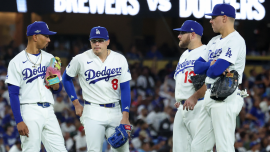
On the pitching front, they’re not quite as long in the tooth, but of the established starting pitchers, only Yoshinobu Yamamoto will be on the right side of age 30 next season. That same rotation is shot through with persistent injury concerns, and the Dodgers, for all their organizational merits, aren’t famous for keeping pitchers healthy. There’s also no guarantee that they’ll be able to retain the services of trade deadline acquisition Tarik Skubal this coming offseason.
To be sure, all is not bleak, as the Dodgers have a strong farm system and an impressive base of young talent. Andy Pages and Dalton Rushing to some extent, but most especially Josue De Paula figures to lift both floor and ceiling, and there’s more on the way. However, those in-place and incoming young players may indeed have a hard time replicating the past dynastic excellence of the Dodgers’ current core, and it may be some time before they’re even ready to try. Not all of them, of course, will work out.
In the meantime, the Dodgers must hope that decline isn’t linear for those veteran names above. That’s especially key since the upcoming free-agent class will provide starkly little frontline help beyond Skubal.
2. The next CBA will directly target them
Negotiations are ongoing for the next Collective Bargaining Agreement, and whatever comes out of that complicated wash will very likely affect the Dodgers and their spending capacity in a major way.
The MLBPA — the union representing the players in these talks — will probably never agree to a cap-and-floor system that team owners are demanding, but such an outcome is at least possible. The entire rhetorical push for a cap from the league side is centered on the Dodgers, and whatever structural changes emerge will target the top-end spenders. Speaking of which, there’s already meaningful common ground between players and owners when it comes to making sweeping changes to how MLB shares local revenues, especially local broadcast revenues.
Commissioner Rob Manfred and the owners who tell him what to do want to bundle all these various and sundry local broadcast rights as one, similar to what the NFL does, and peddle them to the highest bidder (or bidders) once the national broadcast rights are up for renegotiation in 2028. With regard to the Dodgers, this writer recently went a-writin’ about this very matter. Here’s the relevant excerpt:
This is keenly relevant to the Dodgers. Under former owner/saboteur Frank McCourt, the Dodgers were in bankruptcy proceedings when McCourt sold them to the current owners, the Guggenheim Group. As a consequence of those court proceedings and a resulting settlement with the league, the Dodgers, after signing an $8.35 billion deal with Time-Warner, were obligated to share a much smaller percentage of their local broadcast revenues than other teams were. The Dodgers on average take in $334 million per year in local broadcast revenues, and that figure grows a bit each year since the contract is backloaded (by the end of it, their annual take will be more than $500 million). By contrast, the Marlins in recent years made less than $50 million each year in local broadcast monies, and even the flagship Yankees take in less than half of what the Dodgers do on an average annual basis, at least in terms of local broadcast revenues. Call it the “Dodgers Exception” if you like. It’s not only giving the Dodgers much greater financial latitude, but it’s also keeping money out of the revenue-sharing pool. That Dodgers broadcast contract runs through 2038, by the way, with a higher payout each year.
…
Nationalizing such broadcasts would eliminate that competitive advantage because it would require MLB to buy out the Dodgers’ contract and or purchase the Dodgers’ regional sports network.
While the MLBPA is not yet on board with such a drastic overhaul of the current revenue-sharing system — they want some incentives to remain for small-market owners to actually invest in the product, which most of them barely do — there is some meaningful shared territory here. Indeed, in their opening proposal to the league back in May, the union called for steeply increased sharing of local broadcast revenues. The upshot is that the next CBA will involve a significant transfer of revenues from large-market clubs to small-market clubs on a sustained basis. That means a financial haircut for the Dodgers and less room in the budget to do what they’ve been doing so well for the past decade or so.
Whatever the specifics, it’s a near certainty that the new CBA, which will take effect before the 2027 season begins — whenever that is — will make the Dodgers’ “dynasty maintenance program” far more difficult.
3. The ownership situation is troubled and perhaps uncertain
No, this isn’t as dire as Frank McCourt somehow managing to bankrupt the cash-printing Dodgers, but principal owner Mark Walter has serious legal and financial worries right now. Once the standard-bearer for proper ownership in MLB, Walter is being investigated by the feds for potential loan fraud through his holding company, TWG Global. At the same time, he’s the subject of multiple lawsuits, one of which is a class action suit alleging mishandling of client retirement funds.
All of this may mean major fines, settlements, or judgments against Walter’s interests. Walter has already sold his controlling share of the NBA‘s Lakers and his minority stake in Chelsea F.C. of the English Premier League. While the Dodgers insist Walter isn’t putting the club up for sale, it’s hard to trust what parties with vested interests say about such things. Even if Walter doesn’t sell the Dodgers, it’s entirely possible, maybe even likely, that his appetite for spending on player payroll will be diminished. And that’s assuming he’ll even be allowed to spend at such levels according to the terms of the next CBA.
Never count an Andrew Friedman team out, of course, and the Dodgers aren’t suddenly going to tumble to a win total in the seventies next season. They’ll still probably be among the top quartile of MLB teams. However, their fading ability to dominate — the Brewers had a better record and run differential against a tougher schedule this season — looks poised to continue fading. That’s a jarring reality for the team that’s lorded over the sport for the last decade. But a reality it is.

