Wholesale businesses require more than a generic customer relationship management (CRM) system. A CRM for wholesalers must support account-specific pricing, large product catalogs, repeat orders, and sales workflows that integrate with inventory and fulfillment systems. When these processes are disconnected, quoting slows, errors increase, and revenue opportunities are harder to capture.

The best CRM for wholesale distributors connects customer data with pricing logic, order workflows, and inventory visibility. This setup allows sales teams to move from quote to order without switching systems, while giving operations leaders accurate pipeline insight and enabling field reps to work effectively from mobile devices.
This guide compares the best CRM software for wholesalers in 2026. The guide evaluates each platform based on wholesale-specific requirements like enterprise resource planning (ERP) and inventory integration, mobile field sales capabilities, pricing flexibility, and total cost of ownership.
Table of Contents
What is a CRM for wholesalers?
A CRM for wholesalers is a customer relationship management system designed to support B2B distribution workflows, including account-specific pricing, bulk ordering, and sales processes integrated with inventory and fulfillment systems. It helps wholesale teams manage accounts, generate accurate quotes, and move orders forward without relying on disconnected tools.
Wholesale CRM software supports customer-specific pricing and tiered price lists, allowing distributors to apply contract pricing, volume discounts, and negotiated terms at the account level. It also connects sales workflows to inventory and order status data, typically through integrations with ERP systems.
In practice, the CRM system manages accounts, contacts, deals, and sales activity, while the ERP system manages inventory, purchasing, and fulfillment. This separation allows wholesale teams to maintain accurate operational data while giving sales teams the context they need to quote and sell efficiently. Many of these requirements overlap with those in manufacturing environments, where CRM systems also connect sales activity to production and fulfillment processes.
Wholesaler CRM vs. Standard CRM
Wholesale distribution introduces requirements that standard CRMs do not fully support without additional configuration or integrations. These differences affect how teams price, sell, and fulfill orders.
- Tiered and contract pricing: Wholesale CRM software supports account-specific price lists, volume discounts, and negotiated terms. Standard CRMs typically require integrations or customization to handle this level of pricing complexity.
- Large product catalogs and stock-keeping units (SKUs): Wholesale teams manage extensive product catalogs with multiple variations. Standard CRMs offer basic product records but often rely on external systems for full catalog management.
- Inventory visibility during sales: Wholesale sales teams need access to stock availability when building quotes. Standard CRMs depend on ERP or inventory integrations to provide this information.
- Multi-location inventory: Wholesale distributors often sell across warehouses, branches, or regions. Standard CRMs typically require ERP or inventory integrations to display location-specific stock availability during quoting.
- Repeat ordering workflows: Wholesale operations rely on frequent reorders and order history. Standard CRMs typically require workflows or integrations to support repeat-order processes.
- Electronic data interchange (EDI) and partner requirements: Many wholesalers exchange purchase orders, invoices, and shipping notices via EDI. Standard CRMs rarely support EDI without third-party tools.
- Territory and field sales coverage: Wholesale sales teams often operate on a regional, account-ownership, or product-line basis. While standard CRMs support territories, wholesalers typically require more structured coverage models tied to distribution operations.
Best CRMs for Wholesalers at a Glance
Wholesale CRM requirements often overlap with adjacent industries like retail, but differ in pricing models, order volume, and account structure. See this guide to the best CRMs for retail for a comparison of customer-focused sales environments.
Best CRM Software for Wholesalers
The right CRM helps wholesale teams reduce quoting delays, connect sales activity with inventory data, and give reps clearer account visibility. The six CRM platforms below address different wholesale needs, from field sales and stock-aware quoting to enterprise forecasting and ERP connectivity.
1. HubSpot Smart CRM
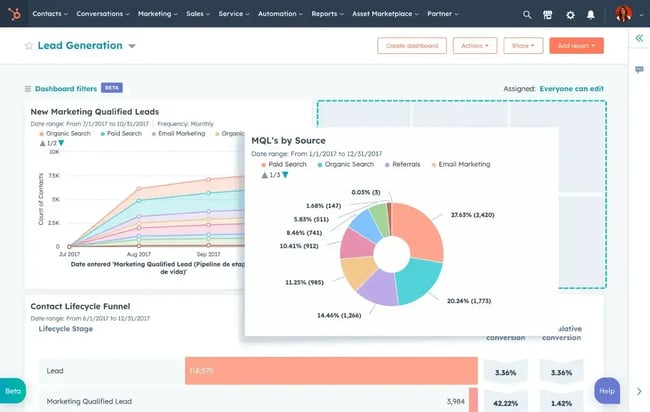
HubSpot Smart CRM is HubSpot’s AI-powered system of record for account, contact, deal, and activity data. For wholesale distributors, it can support quote-to-order workflows through product libraries, quotes, workflows, reporting, and integrations with ERP, inventory, and order management systems.
HubSpot also connects Smart CRM with Commerce Hub and Breeze, HubSpot’s collection of AI tools, so wholesale teams can manage customer data, quoting, billing, payments, automation, and reporting from a shared customer record.
Key Features
- Unified customer view: HubSpot Smart CRM centralizes account, contact, deal, and activity data, giving sales and service teams full visibility into customer relationships.
- Quote-to-cash support with Revenue Hub: Revenue Hub supports quoting, billing, and payments directly inside HubSpot, helping teams move deals to revenue faster.
- Tiered pricing and product library: Product libraries and quote workflows support volume-based pricing structures for wholesale quoting.
- Automation and workflows: Workflows automate lead routing, follow-ups, approvals, and reorder reminders to reduce manual work.
- AI-powered tools with Breeze: Breeze, HubSpot’s collection of AI tools, helps teams generate content, support forecasting, automate workflows, and work with CRM data more efficiently.
- Integration ecosystem: HubSpot Marketplace includes 2,000+ integrations that connect HubSpot with ERP, inventory, and order management systems for real-time data sync.
- Mobile CRM: Sales reps can manage deals, contacts, and tasks from anywhere.
- Free tools with CRM functionality are available
- Starter: From $20/month/seat per HubSpot’s Product & Services Catalog
- Professional: From $50/month/seat, or $45/month/seat when billed annually on the current public Smart CRM pricing page
- Enterprise: From $75/month/seat
Best for: Wholesalers who want a single platform to manage sales, service, and marketing while connecting to ERP and inventory systems
What we like: Combines a unified customer database with automation, AI, and flexible integrations, making it easier to manage complex B2B relationships without adding operational overhead.
2. Pepperi
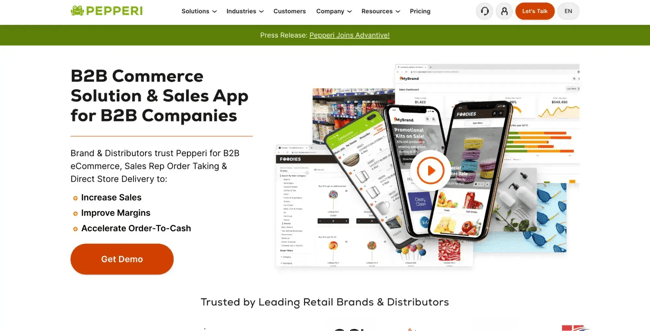
Pepperi combines CRM, B2B commerce, mobile order taking, and field sales tools for wholesale distributors and brands. Sales reps and buyers can use Pepperi to access customer-specific catalogs, price lists, promotions, and order workflows from web and mobile experiences.
Pepperi fits distributors that need stronger field sales execution, offline mobile access, route-based selling, and customer-specific buying experiences.
Key Features
- B2B self-service portal: Customers can browse catalogs, view account-specific pricing, and place orders independently.
- Mobile order-taking: Field reps can create and submit orders on mobile devices, including in offline mode with later sync.
- Multi-price lists and catalogs: Pepperi supports complex pricing structures, customer-specific catalogs, and multiple product catalogs.
- Route accounting and direct-store delivery (DSD): Sales teams can manage route planning, delivery tracking, and field sales execution.
- Order controls: Teams can use approval workflows, order minimums, and cutoff times to manage wholesale ordering rules.
- Inventory visibility: Sales reps can access stock data during sales workflows.
Pricing: Available upon request.
Best for: Wholesale distributors that need a combined CRM, B2B commerce platform, and field sales solution
What we like: Built specifically for wholesale operations, with comprehensive support for mobile sales reps, order taking, and customer-specific catalogs
3. Prospect CRM
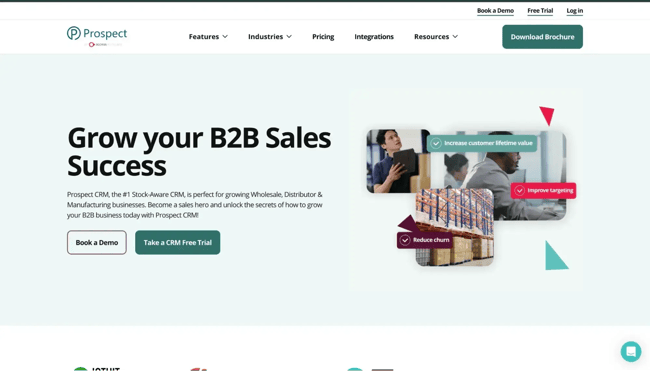
Prospect CRM is a stock-aware CRM built for product-selling B2B businesses. It connects customer, product, sales, and inventory data, enabling wholesale teams to quote, manage accounts, and prioritize sales activity with better visibility into stock and buying patterns.
The platform works especially well for distributors that need CRM records to reflect real product movement, repeat orders, backorders, and cross-sell opportunities.
Key Features
- Stock-aware CRM: Prospect CRM integrates customer, product, and inventory data, allowing sales reps to see real-time stock levels during quoting.
- Quote and order processing: Sales teams can build quotes and process orders with inventory context.
- RFM segmentation: Prospect CRM segments customers based on recency, frequency, and monetary value.
- Cross-sell insights with Magic Matrix: Magic Matrix identifies upsell and cross-sell opportunities based on purchasing patterns.
- Order tracking and backorder visibility: Teams can manage fulfillment expectations and customer communication with order and backorder data.
Best for: Wholesalers who need real-time inventory visibility embedded directly in the CRM
- Start-Up CRM: From $243/month, 4 users included
- Professional CRM: From $482/month, 4 users included
- Advanced CRM: From $2,376/month, 15 users included
- 14-day free trial available
What we like: Purpose-built “stock-aware CRM” that connects sales activity with inventory data, helping reps sell based on what is actually available
4. Zoho CRM

Zoho CRM is a customizable CRM for small- and mid-sized wholesale teams that need sales automation, pipeline management, territory management, and integrations without enterprise-level pricing. Wholesale teams can connect Zoho CRM with Zoho Inventory and other Zoho apps to manage sales activity alongside inventory and order workflows.
Zoho CRM works best for cost-conscious teams that can configure their own workflows and integrations, or that already use other Zoho products.
Key Features
- Process management with Blueprint: Blueprint guides sales reps through structured workflows for quoting, approvals, and follow-ups.
- AI assistant with Zia: Zia provides insights into deal performance, lost opportunities, and cross-sell recommendations.
- Territory management: Zoho CRM supports account assignment by region, team, or product line.
- Lead and account automation: Teams can automate routing, follow-ups, and engagement tracking.
- Zoho Inventory integration: Zoho CRM connects with Zoho Inventory to sync CRM data with stock levels, sales orders, and invoices.
- Mobile CRM: Sales reps can access deals, contacts, and tasks on the go.
Best for: Small to mid-sized wholesalers looking for an affordable CRM with flexible customization and integrations
- Free plan for up to 3 users
- Standard: $20/user/month, billed monthly
- Professional: $35/user/month, billed monthly
- Enterprise: $50/user/month, billed monthly
- Ultimate: $65/user/month, billed monthly
What we like: Strong balance of price and functionality, with process automation and optional inventory integration through the Zoho ecosystem
5. Salesforce Agentforce Sales (formerly Sales Cloud)
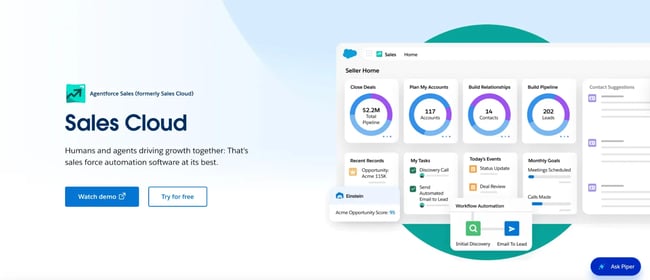
Salesforce Sales Cloud, presented by Salesforce as part of Agentforce Sales, serves sales teams that need deep customization, AI, forecasting, territory management, products, price books, and app integrations. Wholesale distributors can configure Salesforce for complex account structures, pricing models, approval workflows, and multi-team coverage.
Salesforce usually fits larger distributors with the budget and internal resources to support implementation, administration, and ongoing customization.
Key Features
- Products and price books: Salesforce supports multiple pricing structures and product catalogs for different customer segments.
- Territory forecasting: Teams can track revenue performance across regions, reps, and sales teams.
- Advanced customization: Teams can build tailored workflows, objects, automations, and sales processes.
- B2B commerce integrations: Salesforce supports integrations with ecommerce platforms for wholesale ordering.
- Reporting and dashboards: Sales leaders can analyze pipeline, forecast, territory, and performance data.
- App ecosystem: Salesforce’s app ecosystem supports integrations and extensions for enterprise sales workflows.
Best for: Enterprise wholesalers with complex territory structures, pricing models, and customization needs
- Starter Suite: $25/user/month
- Pro Suite: $100/user/month
- Enterprise: $175/user/month
- Unlimited: $350/user/month
- Agentforce 1 Sales: $550/user/month
- 30-day free trial available
What we like: Highly configurable platform with powerful tools for territory forecasting, product pricing structures, and ecosystem integrations
6. Microsoft Dynamics 365 Sales
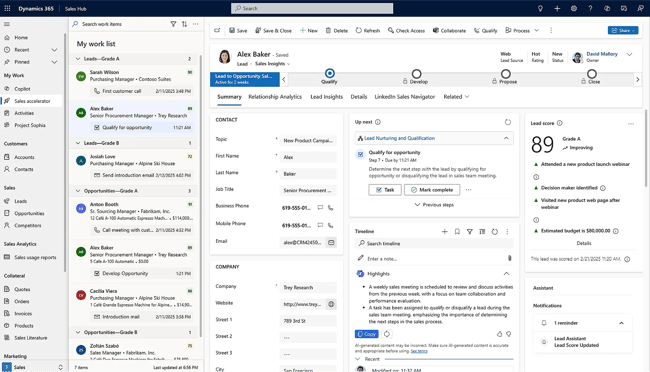
Microsoft Dynamics 365 Sales is Microsoft’s CRM for sales teams that already work in the Microsoft ecosystem. Wholesale distributors can pair Dynamics 365 Sales with Microsoft 365, Power BI, Teams, and Dynamics ERP tools to connect sales activity with product, pricing, quote, order, and fulfillment context.
The platform works best for wholesalers that already use Microsoft tools or want CRM and ERP workflows to sit closer together.
Key Features
- Product catalog and price lists: Microsoft Dynamics 365 Sales supports wholesale and retail pricing models, including volume-based discounts.
- Quote, order, and invoice management: Teams can manage the sales lifecycle from quote to invoice inside the platform.
- Sales territories: Sales leaders can organize accounts and forecasting by region, rep, or coverage model.
- Copilot AI: Copilot helps summarize records, track activity, and improve sales productivity.
- ERP and supply chain integration: Dynamics 365 Sales connects with Dynamics 365 Supply Chain Management for inventory and fulfillment workflows.
- Customer portal capabilities: Teams can use external portals to support order management and account access.
Best for: Wholesalers already using Microsoft tools or requiring tight integration between CRM and ERP systems
- Sales Professional: $65/user/month
- Sales Enterprise: $105/user/month
- Sales Premium: $150/user/month
- 30-day free trial available
What we like: Strong alignment between CRM, ERP, and productivity tools, with built-in support for pricing models and sales territories
Benefits of CRM Software for Wholesalers
Wholesale CRM software improves how teams quote, sell, and manage accounts by connecting customer data with pricing, inventory, and order workflows. For distributors managing high order volume, repeat purchases, and complex pricing structures, a CRM helps reduce manual work while improving visibility across the sales cycle.
Operational Efficiency (Faster Quote-to-cash)
Wholesale teams often rely on multiple systems to build quotes, check pricing, confirm inventory, and process orders. These scattered systems create delays, duplicate work, and inaccurate customer information.
CRM software streamlines this process in several ways:
- Faster quote creation using saved products and pricing rules.
- Improved pricing accuracy with standardized price lists and discounts.
- Improved inventory visibility by connecting CRM data with ERP or inventory systems, helping sales teams quote based on stock.
- Automated workflows for approvals, follow-ups, and handoffs to operations.
- Cleaner transitions between sales and fulfillment teams through shared data.
Where HubSpot fits: HubSpot supports creating quotes directly from deals and automates follow-ups and approvals through workflows. With Commerce Hub, teams can manage quoting, billing, and payments in one system, reducing friction between sales and finance.
Stronger Retention and Account Growth
Wholesale growth depends heavily on repeat orders and long-term account relationships. Without a CRM, account history, communication, and purchasing patterns are often scattered across systems or tied to individual reps. This makes it difficult to maintain continuity when ownership changes or to identify growth opportunities.
A CRM provides a centralized record of every account, including order history, interactions, and engagement across channels. This gives wholesale distribution teams:
- Full account visibility across sales, service, and marketing interactions.
- Continuity across rep transitions with shared account history.
- Ability to proactively manage key accounts based on purchasing behavior.
- Identification of reorder patterns and gaps in purchasing behavior.
- More consistent customer experience across email, phone, and field sales.
Where HubSpot fits: HubSpot’s Smart CRM unifies customer data across teams, making it easier to track account activity and maintain continuity. Workflow automation can trigger reorder reminders or follow-ups based on customer behavior.
For teams handling high volumes of customer communication, CRM functionality often overlaps with call center operations. Explore this guide to the best CRM for call centers for more on managing inbound and outbound interactions.
Revenue Impact and CRM ROI
CRM adoption directly affects revenue by improving sales cycle speed, increasing rep productivity, and providing better visibility into pipeline and account performance. For wholesalers, the largest gains typically come from reducing manual work, capturing more repeat orders, and identifying upsell and cross-sell opportunities.
A CRM also improves forecast accuracy by keeping pipeline data up to date and linking sales activity to revenue outcomes. This allows leadership teams to make more informed decisions about inventory, staffing, and growth planning.
Common revenue drivers from CRM adoption include:
- Shorter sales cycles because of faster quoting and approvals.
- Higher rep productivity by reducing administrative work.
- Improved pipeline hygiene and forecast accuracy.
- Increased average order value through cross-sell and upsell visibility.
- Reduced system switching by integrating CRM with ERP, inventory, and order management tools.
To estimate a CRM system’s ROI impact, wholesale teams often look at:
- Quote time, or the hours spent creating and revising quotes per week.
- Admin time, or the time spent updating spreadsheets, emails, and disconnected systems.
- Cost per order, or the operational cost tied to manual processing and errors.
- Missed revenue, or lost orders from slow response times or lack of follow-up.
- Retention rate, or revenue tied to repeat customers and reorder frequency.
Even minor improvements across these areas can compound into meaningful revenue gains.
Where HubSpot fits: HubSpot combines pipeline tracking, reporting, and automation into a single platform, helping teams maintain cleaner data and improve forecasting accuracy. AI tools like Breeze assist with prioritization and task execution, reducing the time spent on manual work.
8 Important Features for a Wholesale CRM
Wholesale CRM software must support complex pricing, high-volume ordering, and sales processes connected to inventory and fulfillment systems. The features below reflect the capabilities most distributors need to manage accounts efficiently and scale operations.
1. Customer-Specific Pricing and Quoting
Wholesale CRM software supports account-specific pricing, including contract pricing, volume discounts, and negotiated terms. This ensures quotes reflect agreed pricing without manual adjustments.
Look for:
- Tiered pricing and price lists.
- Custom quote templates.
- Approval workflows for pricing exceptions.
HubSpot supports product libraries and quote creation directly from deals, with tiered pricing capabilities available through Commerce Hub.
2. ERP and Inventory Integration
Wholesale CRM software connects sales workflows to inventory and order data so reps can quote based on available stock and track fulfillment status without switching systems.
Look for:
- Two-way data sync with ERP or inventory systems.
- Visibility into stock levels and order status.
- Integration with purchasing and fulfillment workflows.
HubSpot integrates with inventory and ERP tools through HubSpot Marketplace, enabling shared visibility across systems.
For organizations managing more complex delivery, warehousing, or supply chain workflows, CRM requirements often extend into logistics coordination. See this guide to the best CRMs for logistics businesses for additional options.
3. Product Catalog and SKU Management
HubSpot product libraries help sales teams organize products and add the right items to quotes without having to rebuild catalog information from scratch.
Wholesale teams manage large product catalogs with multiple SKUs, variations, and pricing structures. A CRM should support organizing and accessing this data during sales workflows.
Look for:
- Centralized product library.
- Support for large catalogs and multiple price lists.
- Easy product selection during quote creation.
4. Repeat Order and Reorder Workflows
Wholesale operations depend on repeat purchases. CRM software should help teams track buying patterns and trigger follow-ups based on reorder timing. This helps prevent missed reorder opportunities and improves account retention.
Look for:
- Order history tied to accounts.
- Automated reorder reminders.
- Alerts for gaps in purchasing activity.
HubSpot workflows can automate follow-ups and reminders based on customer behavior or deal activity.
5. Territory Management and Account Ownership
Wholesale sales teams are often structured by region, account coverage, or product line. CRM software should support clear ownership and territory-based reporting.
Look for:
- Territory assignment by geography or segment.
- Account ownership tracking.
- Reporting by territory or rep.
HubSpot helps teams assign and track account ownership with company records, properties, lists, and reporting views that reflect territory or coverage models.
6. Mobile Access for Field Sales Teams
Field sales reps need access to CRM data while visiting customers, placing orders, or managing accounts on the go.
Look for:
- Mobile apps for iOS and Android.
- Offline access with sync capabilities.
- Ability to update deals, contacts, and orders from the field.
HubSpot’s mobile app allows reps to manage deals, tasks, and contacts from anywhere.
7. Reporting and Revenue Visibility
Wholesale CRM software should connect sales activity to revenue outcomes, helping teams track performance and forecast demand.
Look for:
- Custom dashboards and reports.
- Pipeline visibility and forecasting tools.
- Reporting by account, product, or territory.
HubSpot provides customizable dashboards and reporting tools to track pipeline and sales performance.
8. Automation for Sales and Operations Workflows
Automation reduces manual work and ensures consistency across sales and operational processes. This workflow improvement is especially important for wholesalers managing high order volumes and multi-step approval processes.
Look for:
- Workflow automation for approvals and follow-ups.
- Lead and deal routing.
- Notifications for key account or order events.
HubSpot’s workflow automation enables teams to automate repetitive tasks and streamline handoffs between sales and operations.
How to Choose a CRM for Wholesalers (Step-by-step)
Step 1: Map your current processes.
Document existing workflows and identify areas where a CRM could improve efficiency. Consider order processing, customer communication, and reporting needs.
Step 2: Define integration requirements.
List all systems that need to connect with your CRM. Check each platform’s integration options and consider middleware solutions if needed.
Step 3: Calculate total cost of ownership.
Consider subscription fees, implementation costs, training, and ongoing support when evaluating CRM options.
Step 4: Involve key stakeholders.
Include representatives from sales, customer service, and operations in the decision-making to ensure the CRM meets all departmental needs.
Step 5: Test with real scenarios.
Use free trials to test CRMs with actual business scenarios. If a free trial isn’t available, book a demo with a sales rep. Create sample quotes, manage test orders, and evaluate ease of use.
Step 6: Plan for scalability.
Pick a CRM that can grow with your business. HubSpot’s scalable platform allows businesses to start with free tools and add features as they grow.
Frequently Asked Questions
What is the best CRM for wholesalers?
The best CRM for wholesalers depends on business size, sales complexity, and the degree to which it needs to integrate with inventory, pricing, and order systems.
HubSpot is a strong option for teams that want a unified platform for sales, service, and marketing, with automation, AI tools, and integrations that connect CRM data with ERP and inventory systems. This makes it well-suited for wholesalers looking to streamline quote-to-order workflows and improve visibility across the customer lifecycle.
What features should I look for in a wholesale CRM?
Wholesale CRM software should support pricing complexity, inventory-connected sales workflows, and repeat ordering. Key features include customer-specific pricing and quoting, ERP and inventory integration, product catalog management, and automated reorder workflows.
Additional capabilities such as territory management, mobile access for field sales teams, revenue-linked reporting, and workflow automation help wholesalers scale operations and maintain accurate pipeline visibility.
Platforms like HubSpot support these features through product libraries, automation, and integrations with inventory and ERP systems.
Is HubSpot suitable for wholesale businesses?
Yes, HubSpot is suitable for wholesale businesses, particularly those looking to centralize sales, service, and marketing on one platform.
HubSpot supports wholesale workflows through customizable properties, automation, and integrations with ERP and inventory systems. Features like product libraries, quote creation, and Commerce Hub help teams manage pricing and move deals from quote to payment more efficiently. Breeze, HubSpot’s collection of AI tools, also helps teams automate tasks, prioritize opportunities, and maintain cleaner pipeline data, which is critical for managing high-volume, repeat-order sales environments.
How much does a wholesale CRM typically cost?
CRM costs vary widely depending on features, number of users, and the level of customization required.
For example, Pepperi starts at $500/month for its Pro plan, while Prospect CRM begins at approximately $243 for four users. Zoho CRM offers more affordable per-user pricing starting at $20/user/month, making it a common choice for smaller teams. Enterprise platforms like Salesforce and Microsoft Dynamics 365 typically start at higher per-user price points.
HubSpot offers free tools with CRM functionality, including contact management, deals, and reporting. HubSpot’s Product & Services Catalog lists Smart CRM Starter at $20/month/seat, Smart CRM Professional at $50/month/seat, and Smart CRM Enterprise at $75/month/seat; the current public Smart CRM pricing page also shows annual promotional pricing for Professional at $45/month/seat.
Meet HubSpot, a top CRM choice for wholesale distributors.
HubSpot stands out as a flexible CRM solution for wholesalers seeking to modernize operations, streamline quote-to-order workflows, and build stronger customer relationships. Here’s why wholesale businesses choose HubSpot:
- Flexible platform: HubSpot Smart CRM adapts to wholesale workflows, including account management, sales pipelines, quoting, reporting, and integrations.
- Unified operations: The platform brings together sales, marketing, and service tools, sharing data and integrating functionality. This allows teams to manage accounts, pricing, and communication in one place. HubSpot’s AI capabilities, including Breeze, help automate tasks and improve visibility across the customer lifecycle.
- Quote-to-cash support: With Revenue Hub, teams can manage quoting, billing, and payments directly within the CRM, helping reduce delays between sales and revenue.
- Proven results: Companies across manufacturing and distribution see measurable improvements with HubSpot. VELUX, a manufacturer of skylights, reduced simulation wait times from 2–3 weeks to minutes using HubSpot’s AI tools, while Cold Jet cut lead response time by 66% as it scaled.
Ready to transform wholesale operations? Start with HubSpot’s free tools with CRM functionality, then add advanced sales, marketing, service, automation, and commerce features as the business grows.
Editor’s note: This post was originally published in July 2025 and has been updated for comprehensiveness.

